Is 7-OH Under Fire? Understanding the 2026 Regulatory Crackdown on Kratom Concentrates
The 7-OH market is moving faster than the law can keep up. From CA's Sherman Law raids to new federal seizures, here is the ground-truth on 7-hydroxymitragynine regulations and how to keep your shop from becoming the next headline
As a shop owner, you’ve seen this movie before. First, it’s a "miracle" new compound that flies off the shelves; then come the headlines, the FDA warning letters, and finally, the local law enforcement showing up with red tags.
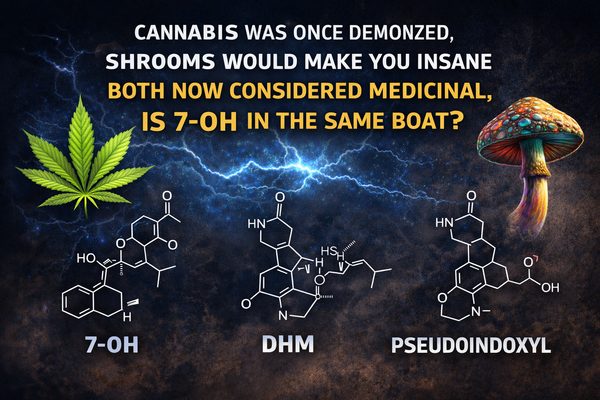
Right now, 7-hydroxymitragynine (7-OH) is the industry's new lightning rod. While it’s naturally occurring in the kratom plant, the rise of semi-synthetic, highly concentrated isolates has put the entire category in the crosshairs of regulators.
Here is the "ground-truth" reality of what is happening with 7-OH in 2026 and what you need to do to protect your shop and your customers.
The Current Landscape: Where the Heat is Coming From
The 2026 regulatory environment has shifted from "observation" to "aggressive enforcement." If you are moving 7-OH products, you need to track these three fronts:
- California’s "Sherman Law" Offensive: The California Department of Public Health (CDPH) has launched the largest crackdown in state history. They aren't just sending letters; they are seizing millions of dollars in inventory. They’ve interpreted the Sherman Food, Drug, and Cosmetic Act to classify 7-OH as an "unapproved food additive," making it illegal to sell for human consumption statewide.
- FDA and U.S. Marshals: In late 2025, the FDA coordinated with U.S. Marshals to seize over $1 million worth of 7-OH products (shots, tablets, and gummies) from distributors in Missouri. This signals that the federal government is targeting the supply chain at the source.
- The Florida Model: Florida recently moved to classify concentrated 7-OH as a Schedule I substance, making its sale a serious felony, even while natural kratom leaf remains legal.
The Science vs. The Hype: Why the Focus on 7-OH?
Regulators are leaning heavily on the "13x more potent than morphine" headline. While that makes for a scary news clip, the pharmacology is more nuanced—but still serious.
- Partial Agonism: Unlike morphine (a full mu-opioid agonist), 7-OH is a partial agonist. In theory, this means it has a "ceiling effect" on respiratory depression (the primary cause of fatal overdoses).
- The "Isolation" Problem: In raw leaf, 7-OH exists in trace amounts (usually <2%). When it is isolated and concentrated into 15mg–30mg tablets, the safety profile changes.
- Metabolic Saturation: Research shows that the body naturally limits how much mitragynine it converts into 7-OH. By bypassing this natural "limiter" with pure 7-OH products, users are hitting receptors harder than the plant ever intended.
Retail Compliance: How to Protect Your Shop
If you’re a retailer who wants to stay in business for the next decade, "I didn't know" isn't a legal defense. Here is your 2026 survival checklist:
- Verify Your COAs: If your 7-OH vendor can’t provide a third-party Certificate of Analysis (COA) for every batch, do not put it on your shelf. You need to prove the product contains what it says and—more importantly—nothing it shouldn't (like Tianeptine or heavy metals).
- Audit Your Marketing: Avoid any medical claims. Do not mention "pain relief," "anxiety cure," or "opioid withdrawal." Stick to "botanical wellness" and ensure all products are labeled "Not for Human Consumption" where required by local law.
- Monitor the "Heat Map": States like Alabama, Arkansas, Indiana, and Louisiana have full bans. States like Arizona, Colorado, and Utah have restricted 7-OH to <2% of total alkaloid content. If your inventory doesn't match your state's specific limit, it's a liability, not an asset.
The Shop Owner's Rule of Thumb: If a product looks like candy, is marketed like a pharmaceutical, and has no traceable lab work—it's not worth the risk to your business license.